
The Mixed-Fleet Maintenance Puzzle
Building a Shop That Can Handle Whatever Rolls In
If you walk into just about any heavy-duty fleet garage in America right now, you’re going to notice something pretty quickly. The days of the uniform shop, where every single tractor pulling into a bay had the exact same diesel powerplant, the exact same layout, and the exact same set of filters, are fading fast into the rearview mirror.
Instead, what you’ll find is a bit of a logistical jigsaw puzzle.
In Bay 1, you’ve got a conventional 2012 diesel workhorse that’s clocked half a million miles and needs an in-frame overhaul. In Bay 2, there’s a hybrid-electric delivery box truck waiting on a complex component swap. And over in Bay 3, a technician is wearing high-voltage safety gloves, hooked up to a laptop, diagnosing an all-electric transit bus.
It’s what the folks in suits call a “mixed powertrain fleet.” But if you’re the one holding the clipboard or the wrench, it’s usually just called a headache.
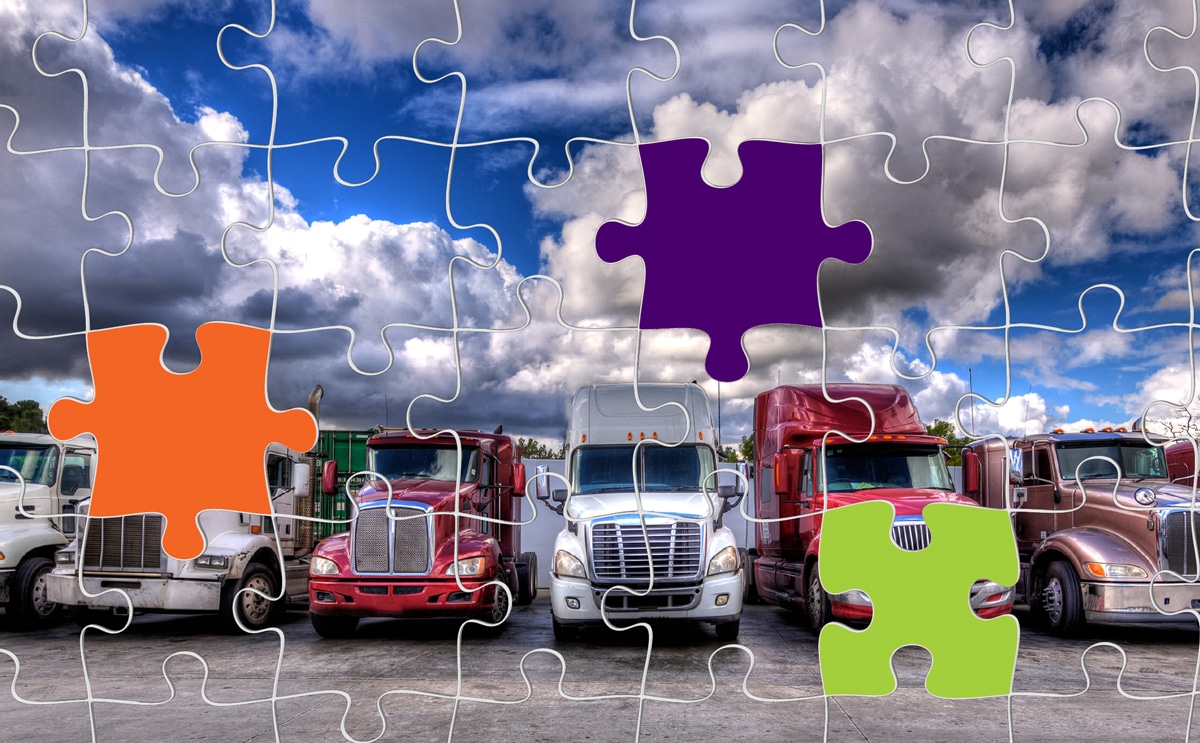
The reality of 2026 isn’t that the world flipped a switch and went entirely electric overnight. The transition is a slow, grinding crawl. Internal combustion engines (ICE), hybrids, compressed natural gas (CNG), and battery-electric vehicles (EVs) are going to be forced to peacefully coexist on the same shop floor for a long time to come. And that reality introduces a massive challenge for service managers: tool proliferation and bay stagnation.
Think about it. If you have to buy a completely different set of highly specialized, rigid maintenance infrastructure for every single type of vehicle that rolls into your bays, you’re going to run out of capital—and physical floor space—in a hurry. You can’t afford to have a bay sitting completely empty and burning through your productivity just because it’s “the EV bay” and no electric trucks are scheduled for service today.
In a world full of powertrain variables, your shop equipment needs to be a constant.
Your diagnostic software might require four different platforms and a dozen specialized digital toolsets, but your heavy-duty lifts shouldn’t care what’s under the hood or how the wheels are getting their torque.
That’s where true operational flexibility comes into play:
Universal Adaptability
A heavy-duty vehicle is still a heavy-duty vehicle. Whether it’s carrying lithium-ion battery packs along the frame rails or a massive diesel engine over the front axle, it still needs to be raised safely, quickly and evenly.
ARI-hetra’s Battery-Powered Wireless Mobile Column Lifts handle the job at the tires, independent of powertrain or chassis configuration. With lifting capacities designed for everything from medium-duty work trucks to heavy-duty buses and commercial vehicles, the columns can be repositioned as the fleet changes instead of dedicating permanent infrastructure to a particular vehicle type.
Agile Workspace Management
When the shop backs up, any available patch of concrete can become valuable real estate. Fixed lifts keep your capacity tied to dedicated bays. ARI-hetra’s mobile column lifts bring the lifting equipment to the vehicle, allowing technicians to put available floor space to work and roll the columns away when the job is finished.
Battery-powered wireless operation takes that flexibility even further. There are no communication cables between columns, while ARI-hetra’s electromechanical ball-screw technology eliminates the hydraulic fluid, hoses and seals found in traditional hydraulic systems. The result is a cleaner, highly maneuverable lifting system designed to reduce maintenance and help keep the shop moving.
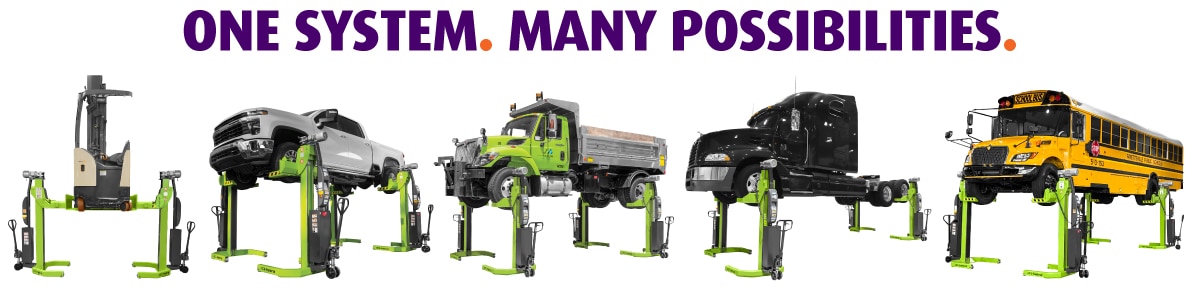
ARI-hetra offers mobile column lift configurations spanning medium and heavy-duty applications. New 36,000 and 56,000 lb. systems bring the technology to pickups, vans and medium-duty trucks, while the higher capacity systems can be configured with up to eight columns and 144,000 lbs. of total lifting power.
Direct, No-Nonsense Support
Onboarding new vehicle technologies is stressful enough for your crew without having to chase down some third-party distributor who doesn’t understand the equipment they sold you. At ARI-hetra, we sell directly to you. There’s no middleman. We’re employee-driven and customer-obsessed, meaning when you need an answer or a hand to keep your shop moving, you get a straight answer from an expert who treats your operation like family.
So whether tomorrow’s schedule calls for a diesel tractor, a hybrid delivery truck, an electric transit bus—or all three before lunch—you don’t need a different lifting strategy for every powertrain that comes through the door.
The vehicles may keep changing. Your ability to get them in the air, get them serviced and get them back on the road shouldn’t.

