
Defeating the Downtime Demon
Keep downtime from haunting your fleet, and shop productivity from disappearing.
 There are plenty of things that can keep a fleet manager up at night. A truck that throws a fault code halfway through a route.
A bus that suddenly needs brake work. A refuse vehicle sitting dead when tomorrow’s route is already full.
But there’s one monster hiding behind nearly every maintenance headache: downtime.
And unlike the creatures that show up every October, this one is very real.
When a vehicle isn’t moving, it isn’t hauling freight, picking up passengers, responding to emergencies, collecting waste or doing whatever job your operation depends on it to do. And when fleets are running around the clock with tight schedules and limited spare assets, there isn’t much room for equipment to sit around waiting for its turn in the shop.
The Cost That Keeps Coming Back From the Dead
Downtime has always been expensive. Right now, the stakes are getting even higher.
According to the American Transportation Research Institute’s 2026 Operational Costs of Trucking report, the average cost of operating a truck climbed to $2.336 per mile in 2025, the highest level in the report’s history. Repair and maintenance costs alone increased 8.6% year over year.
At the same time, maintenance departments are being asked to squeeze more productivity out of limited resources.
The Technology & Maintenance Council’s spring 2026 survey ranked the technician shortage as the second-largest maintenance concern among fleet members, with technician staffing also landing in the top five.
That makes every productive technician hour more valuable.
Which brings us to something that doesn’t always get enough attention:
The equipment your technicians depend on can either help eliminate downtime or create more of it.
When the Shop Becomes the Bottleneck
Most fleets spend a lot of time thinking about vehicle reliability. They track preventive maintenance, inspections, fault codes, tire wear and component life.
But what happens when the vehicle is ready for maintenance and the equipment needed to service it isn’t?
A lift is down. A tire machine is waiting on service. A brake job takes twice as long because technicians don’t have the right equipment. A vehicle is stuck waiting for an available bay.
Suddenly, the shop becomes the bottleneck.
Fleetio’s 2026 benchmark analysis of nearly 1.2 million vehicles found that nearly half of fleet maintenance work still occurs outside the plan. Among the most commonly reported reasons maintenance falls behind were technician availability and unexpected service volume.
Add unreliable shop equipment to that equation and a busy maintenance schedule can become a full-blown horror story pretty quickly.
The goal shouldn’t simply be getting equipment that can do the job.
It should be getting equipment that can keep doing the job.
Reliability Starts With What’s Underneath
Take the vehicle lift.
It’s one of the hardest-working pieces of equipment in a heavy-duty shop. If it goes down, technicians don’t just lose a tool. They can lose access to an entire service bay.
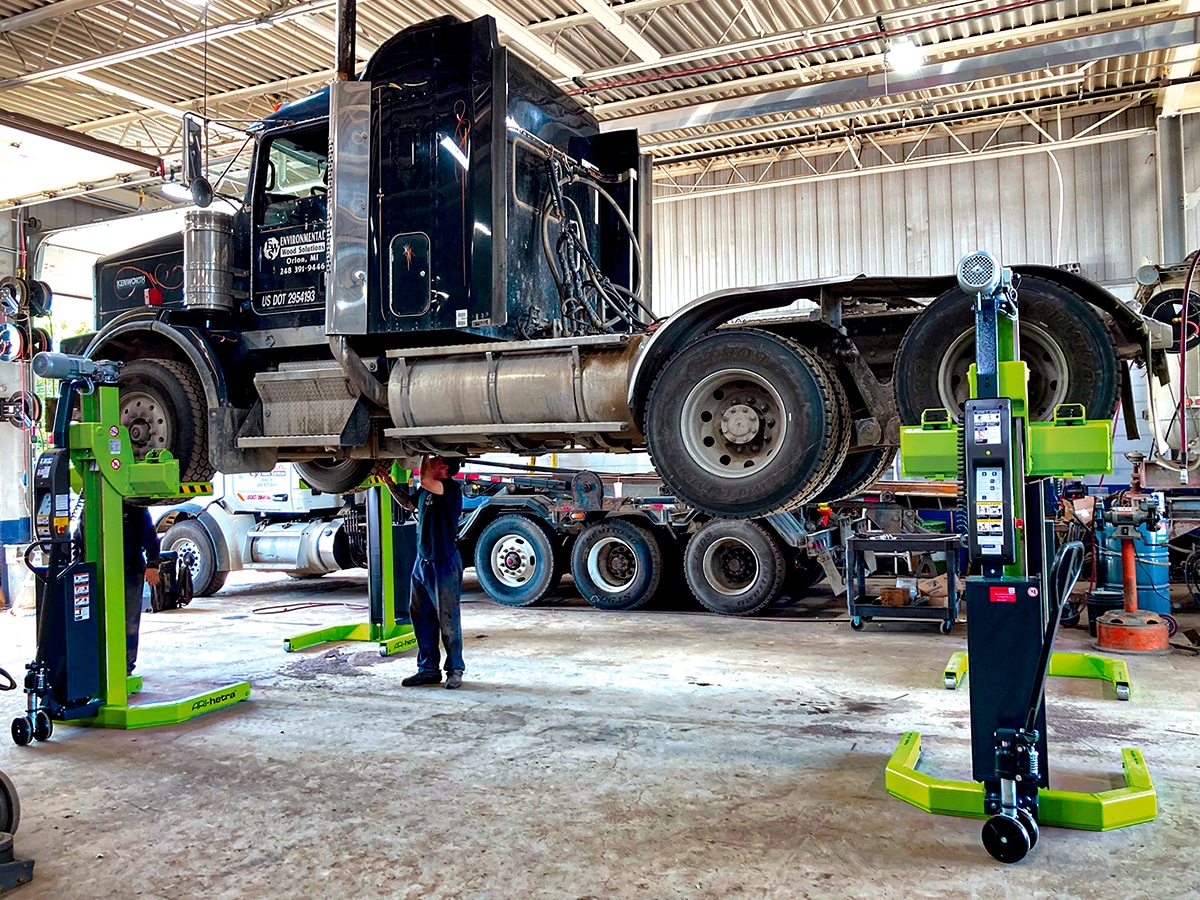
That’s one reason ARI-hetra uses electromechanical ball-screw technology in its Mobile Column Lifts instead of relying on traditional hydraulic lifting systems.
The recirculating ball-screw design eliminates hydraulic cylinders, hoses, seals and fluid from the lifting mechanism.
That means fewer hydraulic components to maintain, no hydraulic leaks and a mechanical system designed for precise, synchronized lifting.
ARI-hetra’s Battery-Powered Wireless Mobile Column Lifts also allow technicians to bring the lift to the vehicle rather than waiting for a fixed bay to become available. Systems can be configured with up to eight columns and capacities reaching 144,000 lbs., giving fleets the flexibility to service everything from medium-duty vehicles to buses and heavy trucks.
No hoses. No hydraulic fluid. And one less potential jump scare on the shop floor.
The Right Equipment Makes Technicians More Productive
The same principle extends beyond lifting.
Brake service, tire changing, wheel balancing, alignment and component removal all consume technician time. The harder those jobs are to perform, the longer the vehicle occupies valuable shop space.
Purpose-built maintenance equipment helps technicians work more efficiently by reducing manual handling, improving access and making demanding jobs easier to perform.
ARI-hetra offers heavy-duty solutions ranging from tire changers and wheel balancers to wheel dollies, brake service equipment, king pin presses and mobile alignment systems.
Because defeating downtime isn’t about finding one magic piece of equipment. It’s about eliminating bottlenecks throughout the maintenance process.
And When Equipment Needs Service? That Matters Too.
Nothing lasts forever. Even well-built shop equipment eventually needs inspection, preventive maintenance or repair.
What happens next can make the difference between a minor interruption and days of unnecessary downtime.
ARI-hetra supports its equipment with a factory-trained service team located throughout North America, preventive maintenance programs, annual lift inspections and direct parts and service support.
Because the last thing a maintenance manager needs when equipment goes down is another mystery to solve.
Put the Downtime Demon Back in Its Grave!
You’ll never eliminate every breakdown.
Vehicles will fail. Parts will wear out. Unexpected repairs will appear on Monday morning like they were summoned over the weekend.
But fleets can control how prepared their shops are to respond.
Reliable maintenance equipment. Flexible shop layouts. Efficient service tools. Preventive maintenance. Responsive support.
Those things may not be as exciting as chasing ghosts, but they can keep a small maintenance problem from turning into something much scarier.
Because when your fleet operates nonstop, your maintenance operation has to be ready to do the same.
Keep the equipment working. Keep the technicians turning wrenches. Keep the vehicles moving. And leave the downtime demons for Halloween.
